From Noise to Signal: the New Era of Voice of Customer
The real problem is not the lack of feedback, but its perceived uselessness
In many brands, customer feedback already exists. There are Google reviews, Instagram messages, comments at the counter, complaints on WhatsApp, a few satisfaction surveys, and sometimes even field audits. On paper, the raw material is there.
The problem lies elsewhere. For the customer, feedback often disappears into a void. They feel they spoke for nothing, with no response, no recognition, and no visible effect. For the business, that same signal arrives fragmented across multiple channels, in different formats, at different speeds, and is rarely turned into clear action.
This is exactly where Voice of Customer breaks down on both sides. On one side, the customer gets tired of it. On the other, the organisation becomes overloaded.
91% of dissatisfied customers never complain. They simply leave. In other words, the most valuable data in retail is not only the data you do not analyse. It is also the data that is never expressed, because you have not made sharing it simple enough, useful enough, or credible enough.
In a retail, restaurant, or franchise network, this silence costs more than a bad public review. A bad review is visible. A customer who says nothing simply disappears from the radar.
Why traditional Voice of Customer is no longer enough
For a long time, companies treated feedback as a reporting layer. It is collected, read, commented on, escalated in a few bullet points, and then everyone moves on. That logic may have worked at a small scale. It no longer holds when touchpoints multiply.
Today, a single brand may receive in parallel:
- in-store reviews
- post-purchase feedback
- private messages on social media
- voice notes on WhatsApp
- public comments on review platforms
- field reports via mystery shoppers
- indirect signals visible in-store, such as waiting times or non-compliance
The result is counterintuitive. You have more data, but less visibility. More tools, but fewer decisions. More dashboards, but not necessarily more operational impact.
So the core issue is not collection alone. It is the ability to turn a heterogeneous flow into an actionable signal. As long as that work remains manual, slow, or partial, Voice of Customer remains an interesting concept, not a management system.
What Stripe became for payments, JABB is becoming for customer experience.
This comparison says something simple. The point is not just to “surface” reviews. The point is to make customer experience actionable, end to end.
What AI really changes: it structures what was previously unclear
AI has changed the very nature of feedback. What was previously difficult to use at scale has finally become readable. A voice note, a photo, free text, a social comment, a call, or a WhatsApp message can now be structured across a few dimensions that are useful for action.
For example, the same piece of feedback can be linked to:
- a location
- a time
- a channel
- a sentiment
- an intention
- a stage in the customer journey
- a team or point of sale
This is where you move from noise to signal.
When a customer says out loud that “the service was slow but the team was kind”, they are not delivering neatly categorised data. They are describing an experience. Without AI, that input remains diffuse. With AI, it becomes comparable, sortable, and prioritised.
One thing is certain: JABB could not have existed in 2022. Not because the need did not exist, but because the technology was not yet mature enough to make this loop fluid, at scale, in a real-world environment.
Today, it is no longer just possible. It has become decisive.
From capture to action: how the closed loop works
A good Voice of Customer strategy does not stop at listening. It must close the loop. That means capturing a signal, understanding it, assigning it to the right place, triggering an action, and then proving that something was done.
At JABB, this logic is built on a coherent ecosystem rather than a standalone tool.
1. Capture easily, where the customer is
With JABB App, you place a QR code at the counter or along the journey, and the customer can share feedback by voice, photo, or text, with no download required. The experience is fast, AI-guided, and rewarded with JABBeez.
This point is essential. If giving feedback requires too much effort, you only hear from a minority of highly motivated customers, often either very happy or very unhappy. If it is simple, immediate, and credible, you capture a more representative voice.
2. Structure automatically
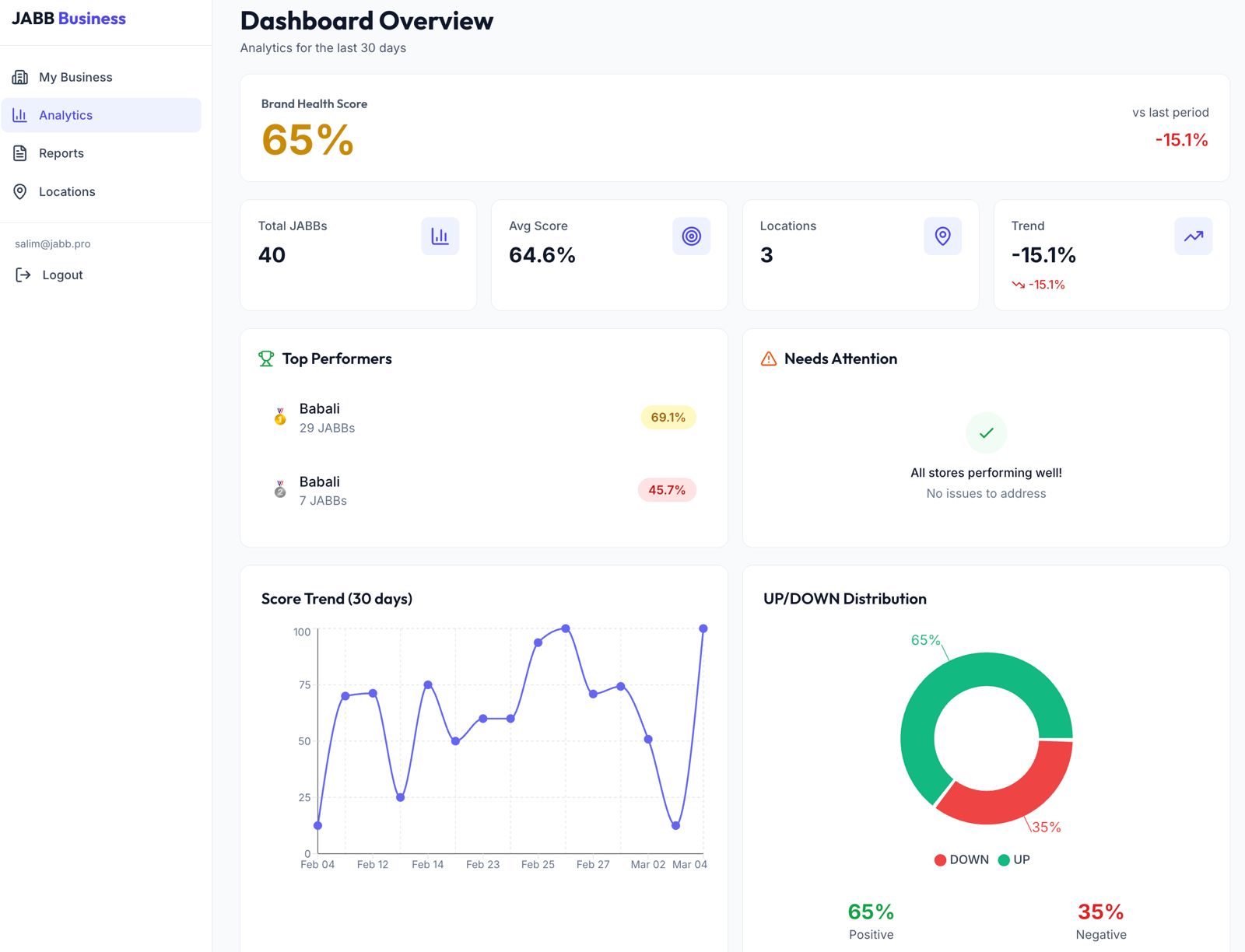
Once captured, the feedback enters JABB VOC, the real-time cockpit for customer experience. Each review is linked to a site, a team, a time, and a channel. Emotions, sentiment, themes, and journey stages become visible without manual reprocessing.
You are no longer just reading verbatim comments. You are seeing context.
3. Trigger action
When a signal requires intervention, it must leave the dashboard. This is where prioritised action plans, instant alerts, and the closed loop come into play. The goal is not to inform faster, but to fix faster.
In some cases, the action can be immediate: call a customer back, resolve a queue issue, alert a manager, check a stockout, relaunch recovery with a coupon. In others, it requires deeper investigation.
4. Prove to the customer that their voice matters
This is the moment many systems forget. If the customer has shared feedback and sees no follow-up, the promise collapses. Conversely, if the company shows that feedback was delivered, acknowledged, and acted upon, trust changes in nature.
Voice of Customer then becomes a relationship mechanism, not just an analytical one.
A useful platform connects several truths, not just one source
A common mistake is to believe that Voice of Customer is limited to feedback explicitly left by customers. In reality, customer experience can also be read through indirect signals, field evidence, and observed data.
This is where value increases significantly.
Declared feedback
This includes reviews left directly by customers via JABB App, but also those coming from the web and social media via Sonar. Sonar listens to reviews, social networks, forums, and the press, scores them, classifies them, and links them to points of sale in JABB VOC.
This gives you a unified view of what your customers say with you and what they say elsewhere.
Proven feedback
With JABB CX, mystery shopping scales across a network. Assignments are given to the most qualified Jabbers, using your own scorecards, with verified evidence, scoring, and recommendations.
This is particularly useful when you want to test a hypothesis. For example: “Is the problem really related to service at certain time slots?” Instead of debating, you assign, observe, and score.
Observed feedback
With Keeps, your existing cameras start speaking. Without facial recognition, Keeps uses AI vision to understand footfall, queues, hot zones, hygiene, compliance, merchandising, or incidents, with a WhatsApp alert in 18 seconds from event to alert.
This changes the nature of management. You no longer wait for a customer to complain about a queue that is too long or a standard that is not being followed. You detect the signal before it becomes expressed frustration.
What changes for a multi-site executive
In a network, the difficulty is not just knowing that there is a problem. It is knowing where, when, how often, and with what likely impact.
Imagine a chain of 20 stores. A director may receive field feedback, read a few reviews, call two or three managers, and form an intuition. But they will often lack a consolidated and comparable view.
Here is the difference between fragmented management and orchestrated management:
| Topic | Fragmented approach | Orchestrated approach with JABB |
|---|---|---|
| Collection | Reviews scattered across channels | Unified, multimedia reviews linked to sites |
| Analysis | Manual, occasional reading | AI structuring by theme, sentiment, time, journey |
| Responsiveness | Depends on local teams | Instant alerts and prioritised action plans |
| Verification | Perceptions and informal exchanges | Field evidence via JABB CX and Jabbers |
| In-store observation | Late, often subjective signal | Keeps on existing cameras, without facial recognition |
| Network management | Difficult comparisons | Multi-site benchmarking in JABB VOC |
This orchestration becomes even more powerful with Three, JABB’s AI strategist. Three does not just respond with what it already finds. It queries your reviews, your assignments, your cameras, and your web mentions. And if the data does not yet exist, it can create an assignment and dispatch Jabbers into the field to get the answer.
In other words, you move from an AI that comments on the existing state to an AI that mobilises humans to fill the blind spot.
The most practical use cases in retail, restaurants, and franchising
When talking about Voice of Customer, the risk is staying at the level of theory. In practice, teams want simple, visible, repeatable use cases.
Here is where the move from noise to signal creates the most operational value:
- identify a recurring issue by point of sale, instead of handling complaints one by one
- spot the moments in the journey that create the most friction
- distinguish an isolated incident from a process problem
- compare multiple sites in a network objectively
- react in real time when a topic deteriorates
- reconnect head office and the field around the same reading
In restaurants, this may concern waiting time, perceived hygiene, product availability, or quality of service. In retail, it may affect shelf availability, checkout flow, merchandising, compliance, or advisory quality.
And in phygital environments, AI Experiences open up another lever. An interactive kiosk, an AI photo experience, virtual try-on, or an event activation are not just engagement tools. Every interaction becomes a data point in JABB VOC, and therefore an additional signal for understanding traffic, conversion, and customer reactions.
The key point is this: the more measurable your physical experience becomes, the more complete your Voice of Customer becomes.
A simple method for moving from noise to signal
If you want to move forward without launching an overly broad programme, here is a practical step-by-step method.
- Choose one primary point of truth
Start with a clear scope: a pilot site, a region, a store category, or one moment in the journey.
- Reduce friction on the customer side
Deploy a simple, fast, visible collection method, such as a QR code with voice, photo, or text feedback via JABB App.
- Centralise in a single cockpit
Bring signals together in JABB VOC so you can read themes, sentiments, journeys, and priorities from one screen.
- Add a field evidence source
Depending on your need, reinforce with JABB CX for mystery shopping assignments, Sonar for social listening, or Keeps to observe what is really happening in-store.
- Close the loop
Define who acts, within what timeframe, and how the action is proven to the customer or the network.
- Learn before scaling
Once the first patterns are visible, expand progressively to other points of sale and use cases.
This logic is more effective than a large theoretical programme. It builds trust quickly, because everyone can see the link between a received signal and a concrete improvement.
Where to start
If you want to turn Voice of Customer into a decision system, not just a listening channel, start with three simple actions:
- Make customer expression immediate with a lightweight in-store setup, no download required, able to capture voice, photo, and text.
- Unify your signals in a single cockpit to connect each piece of feedback to the right site, the right moment, and the right journey.
- Add operational proof with Jabbers assignments, social listening, or AI vision on your existing cameras.
The real challenge is no longer collecting more reviews. It is making sure every signal matters, is understood, and is then turned into a decision.
To see how JABB can close this loop across your network, book a demo at jabb.cx/demo.